AI in construction is now common, but most firms are not getting much from it yet. Two recent stories explain why, and what the firms that are getting value have in common. The short version: AI pays when it lives inside the systems your crews and PMs already use, not in a separate browser tab.
The number worth two minutes of your time
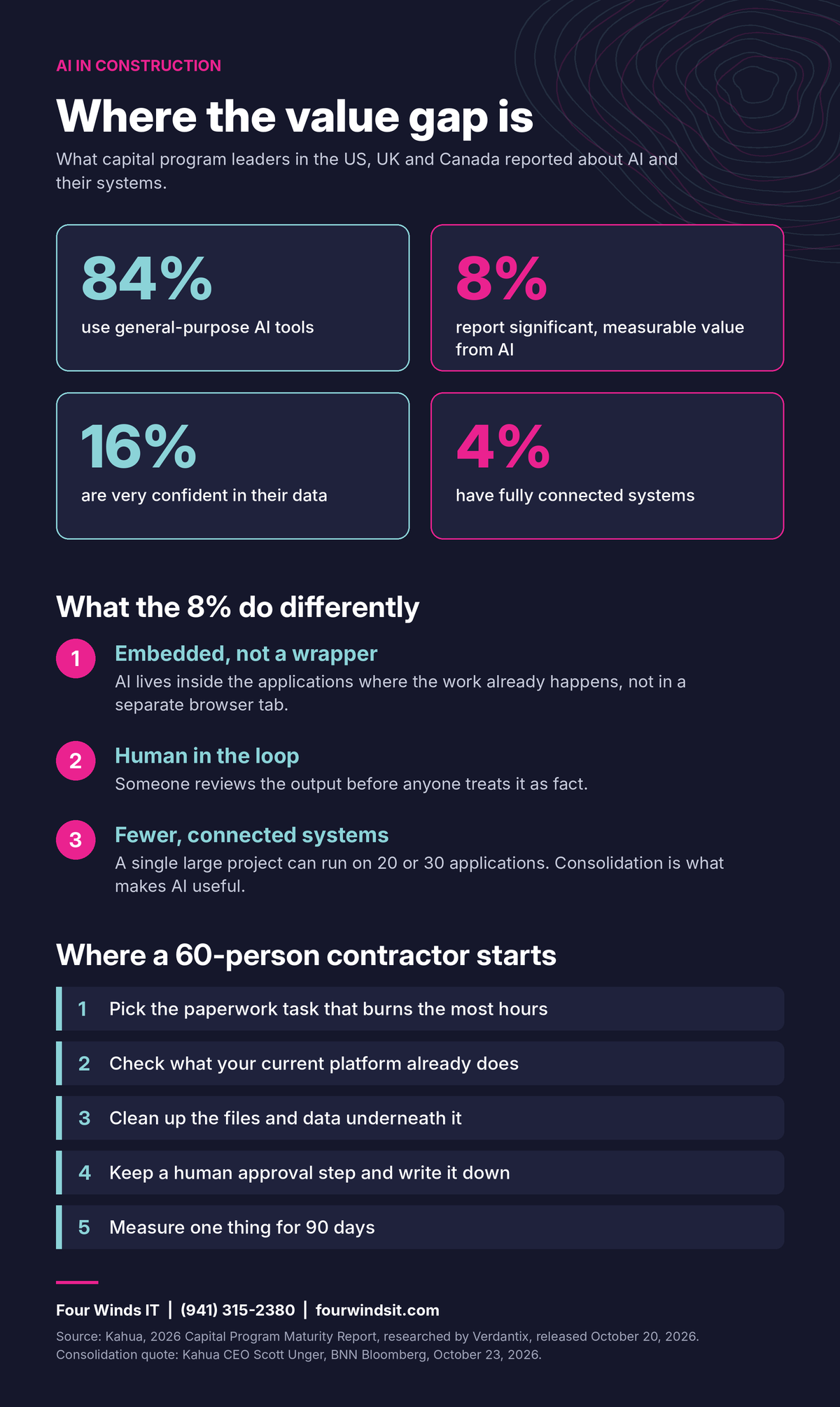
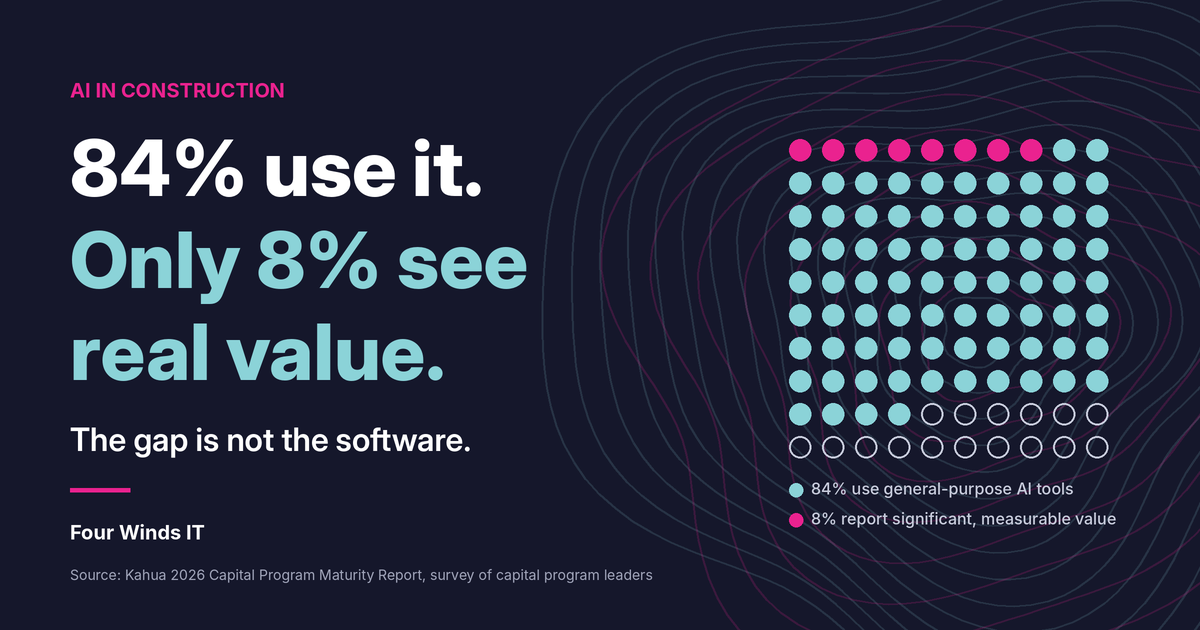
Kahua's 2026 Capital Program Maturity Report, researched by Verdantix and released October 20, surveyed capital program leaders in the US, UK and Canada. 84% of them use general-purpose AI tools. Only 8% report significant, measurable value from their AI investments. Kahua CEO Scott Unger talked through those results in an interview published October 23.
The usual reaction to a spread like that is that AI is overhyped in construction. I would read it the other way. Four out of five are using it. One in twelve is getting real value. That is not a technology failure. That is a sorting process, and it is still early enough to end up on the right side of it.
Unger pointed to three things that separate the firms getting value: AI embedded into the applications where work already happens rather than a wrapper on top, a human in the loop reviewing output before anyone treats it as fact, and fewer disconnected systems feeding it. He said a single large project can potentially have 20 or 30 different applications. Most firms I work with in Southwest Florida are not running 30 systems, but five or six that do not talk to each other is extremely common, and the effect is the same.
What Procore's new AI agents signal for construction AI tools
A day after the Kahua report, at its Groundbreak conference, Procore rolled out a set of AI agents aimed squarely at paperwork. A submittal agent that is now live. A bulk submittal workflow, built with McCownGordon, that can handle up to 500 submittals at once. A dynamic submittal plan. A procurement log, still in closed beta, that could eventually replace the spreadsheet you are tracking procurement in. Plus Procore AI Go, a voice-first mobile app in open beta for North American customers that answers questions from project data, and a Meta AI glasses integration in closed beta.
Notice what none of those are. None of them are a chatbot you open and prompt. They are agents pointed at a specific, repetitive, high-volume task inside a system that already holds your project data. That is the pattern the 8% figured out.
Also notice what drove the bulk submittal feature: it was the number three request from Procore users. The useful AI work right now is not visionary. It is the twelve things your PMs complain about every Friday.
Why the browser tab does not work
A general contractor using a public chatbot to rewrite a subcontractor email is getting a small, real benefit. It is also invisible, unrepeatable, and ungoverned. Nobody else in the company gets faster. There is no record of what was sent. When that PM leaves, the capability leaves with them. If your team is already doing this, a few simple rules for how your team uses AI go a long way.
An agent working inside your project management system has your submittals, your drawings, your schedule, and your permissions. That is the difference between a person being slightly faster and a company being faster. It is the same idea behind a secure AI platform for business that works from your own data instead of a public chat window.
What AI in construction looks like for a 60-person contractor
You probably are not buying Omniverse digital twins this year. Here is the version that fits:
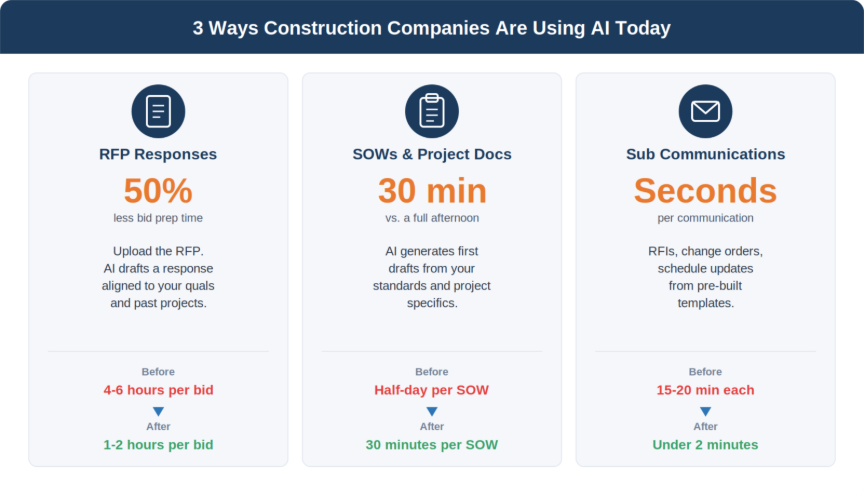
Pick the paperwork task that burns the most hours and creates the most rework. For most of the AEC firms around here that is submittals, RFI tracking, or closeout documentation. On the preconstruction side, it is often bids, which is why we wrote about how an estimator can reply to more RFPs without working weekends.
Check what your existing stack already does. If you are on Procore, Autodesk, or similar, some of this is included or close to it. Paying for a second AI tool to do what your current platform shipped last quarter is the most common waste I see. We coordinate with your software vendors on this rather than replacing them.
Clean up the inputs. Agents are only as good as the data under them. If your drawing sets and project folders are a mess, fix that first. It is boring and it is the whole job. Start with the file storage problems that keep your crew from finding the right file.
Keep a human approval step and write it down. Not as a compliance gesture. Because reviewed output is the only kind you can bill against, and because AI should make your PMs and estimators better at their jobs, not stand in for them.
Measure one thing. Hours on submittal processing per month, before and after. If it does not move in 90 days, change the approach.
The honest limits
Several of Procore's announcements are in beta. The coverage so far does not address pricing or what smaller firms get access to, and it offers no time-saved figures. Anyone quoting you a hard ROI number on this today is making it up. What is real is the direction: the vendors who hold your project data are putting agents on top of it, and the firms with clean data and documented processes will get value from that first.
Frequently Asked Questions
How are construction companies using AI?
Most are using general-purpose AI tools. Kahua's 2026 Capital Program Maturity Report found 84% of capital program leaders use them, but only 8% report significant, measurable value. The firms getting value use AI built into the project systems they already run.
Why aren't construction firms getting value from AI?
Usually because AI sits outside the work. A chatbot in a browser tab has no access to project data, no record of what it produced, and no review step. Disconnected systems and messy data make it worse.
What are Procore's new AI agents?
Procore announced AI agents for submittals, including a bulk workflow that handles up to 500 submittals at once, a dynamic submittal plan, and a procurement log in closed beta. It also launched Procore AI Go, a voice-first mobile app in open beta in North America.
Where should a small contractor start with AI?
Start with one paperwork task that eats the most hours, such as submittals, RFIs or closeout. Check what your current platform already includes, clean up the files and data under it, keep a human approval step, and measure hours saved for 90 days.
Will AI replace project managers or estimators?
No. The firms seeing value keep a human in the loop. AI takes the repetitive paperwork so PMs and estimators can spend more time on the judgment calls and relationships that win and run jobs.
Find out what is already sitting unused
If you want to know which of these is already sitting unused in the tools you pay for, that is a short conversation and usually a surprising one. Book a call or call us at (941) 315-2380.
Want a sense of cost first? Our IT price calculator gives a ballpark for a firm your size. You can also see how we support contractors on our construction IT services page, how our AI implementation and consulting works, and what onboarding looks like.
Sources

 Dylan Borden
 Dylan Borden : Mar 4, 2026, 7:30:00 AM