A practical guide to using AI in your construction company right now — not someday.
Here’s a conversation we have with construction company owners at least once a month: “We’re leaving bids on the table because we don’t have the bandwidth to respond to every RFP that comes across our desk.”
The math is simple. Your estimating team can only produce so many proposals in a week. Every RFP you skip is revenue you’ll never see. But hiring another estimator at $80–100K isn’t the only answer. The real question is: what if your current team could get a quality first draft in front of them in minutes instead of hours?
That’s what AI does when it’s set up correctly. Not the “AI will revolutionize construction” hype you hear at conferences. Practical, right-now tools that your estimators, PMs, and office staff can start using this month.
What This Actually Looks Like
We deploy a secure AI platform for our clients that sits inside your organization — your data stays private, nothing gets used to train outside models, and your team gets access to tools built specifically for business tasks. Here are three things construction companies are using it for today:
First-Draft RFP Responses
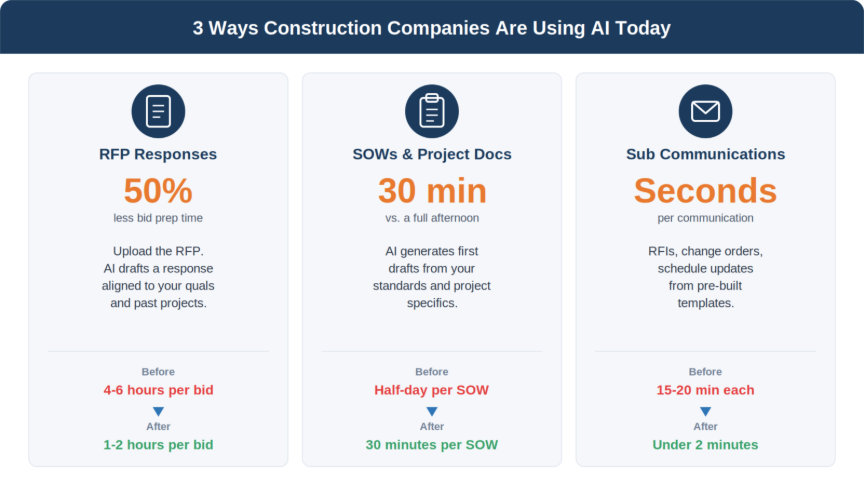
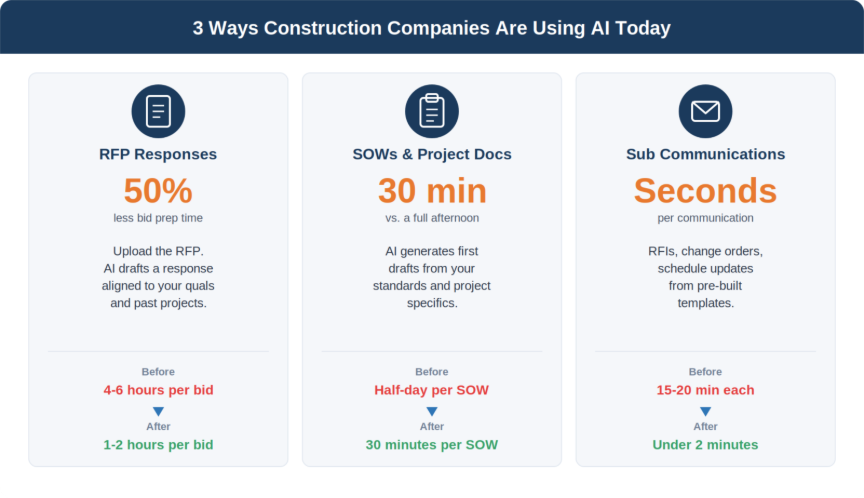
An RFP comes in. Your estimator uploads it to the platform. Within minutes, AI reads the full document, identifies the requirements, and produces a first-draft response that aligns with your company’s qualifications, past project experience, and standard language. Your estimator isn’t starting from a blank page anymore — they’re reviewing, refining, and sending. The output isn’t a final product. It’s a foundation that cuts hours of assembly work down to minutes. Your estimator’s expertise still drives the final bid. They just spend their time on judgment and strategy instead of formatting and rewriting boilerplate.
Project Documentation and SOWs
How much time does your team spend writing scopes of work, project timelines, and budget summaries? These documents follow patterns. AI can generate a first draft based on your company’s standards and the project’s specifics. Your PM reviews it, makes adjustments, and moves on. One PM told us he used to spend a full afternoon on SOW creation for a new project. Now it takes him 30 minutes — and the quality is more consistent because the AI follows the same template every time instead of relying on whatever the PM remembers from the last one.
Subcontractor Communication Templates
RFIs, change order notifications, schedule updates, safety memos — your PMs write variations of the same communications across every project. AI tools with pre-built templates let them generate professional, consistent communications in seconds. The PM inputs the key details, the platform produces the message in your company’s voice. This isn’t about replacing your PM’s communication skills. It’s about eliminating the repetitive writing so they can focus on managing the project.
Why This Isn’t What You Think It Is
When most people hear “AI for construction,” they picture robots on job sites or some sci-fi automation that replaces workers. That’s not this. This is a set of tools that makes your existing people faster at the parts of their job they don’t love — the paperwork, the repetitive writing, the document assembly.
Your estimator still makes the judgment calls on pricing. Your PM still manages the relationships and solves the problems on site. Your office manager still keeps the operation running. They just spend less of their week on tasks that don’t require their expertise.
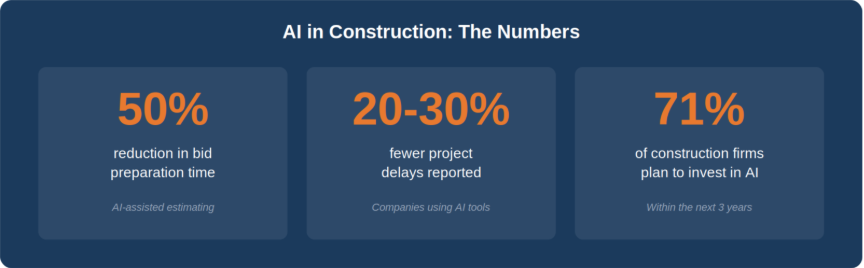
The industry data supports this: AI-assisted estimating reduces bid preparation time by up to 50%. Companies using AI in construction report 20–30% fewer project delays. But the stat that matters most is this one: 71% of construction firms plan to increase AI investment, but only 15% have actually implemented it. That gap is a competitive advantage for companies that move now.
The Security Piece Matters
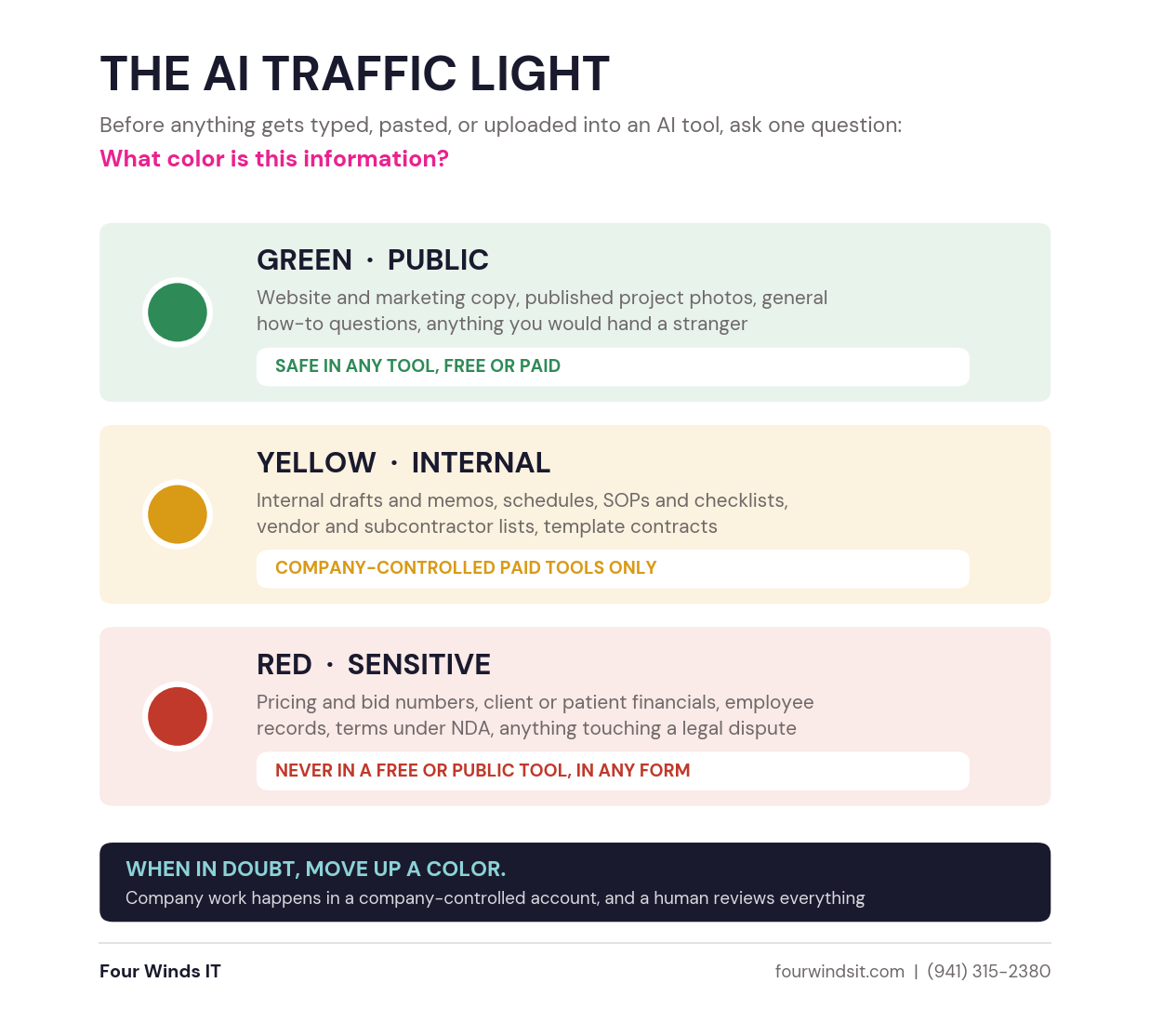
If your team is already using ChatGPT or similar tools on their own, you have a problem you might not know about. They’re potentially feeding bid information, client data, project financials, and proprietary processes into platforms that can use that data to train their models. That means your competitive information could influence responses to anyone — including your competitors.
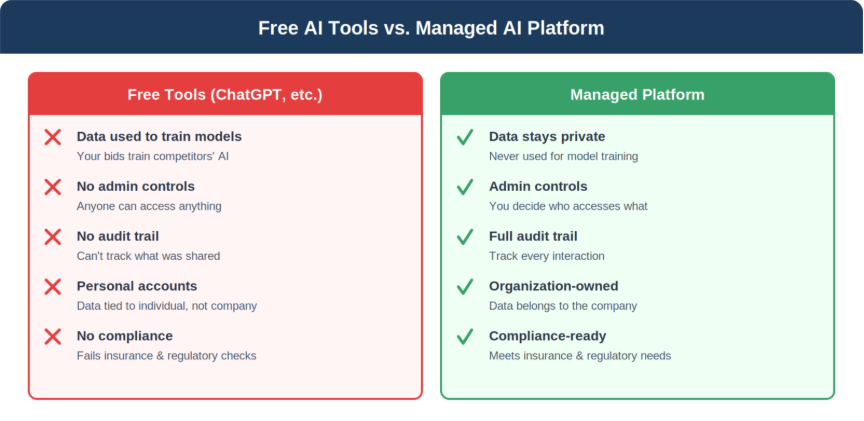
The platform we deploy is organizationally managed. That means your data stays private. Your conversations are never used to train models. You control who has access and what they can do. It’s the difference between your team using random free tools on the internet and having a secure, company-approved AI environment that IT manages just like any other business application.
What It Takes to Get Started
This isn’t a six-figure software implementation. It’s a platform that runs on a credit-based billing model — you pay for what your team uses. A company with 5 heavy users and 20 casual users pays proportionally, not per-seat. Setup takes days, not months. We configure the platform, load your company’s templates and standards, train your team on the tools that matter most to their role, and manage it going forward.
Most of our clients start with one use case — usually the one causing the most pain — and expand from there once the team sees the impact.
The Bottom Line
Your competitors are going to adopt these tools. The question is whether you’re ahead of them or catching up. The companies that figure this out first will bid on more work, produce more consistent documentation, and get more out of the people they already have.
This doesn’t require becoming a “tech company.” It requires the same thing every good GC already does: finding better tools and putting them in the hands of good people.
FAQ: AI for Construction Companies
How can construction companies use AI right now?
Construction companies are using secure AI platforms today for three main tasks: generating first-draft RFP responses from uploaded bid documents, creating project documentation like SOWs and budget summaries from templates, and producing consistent subcontractor communications. These tools reduce bid preparation time by up to 50% without replacing estimators or PMs.
Is AI going to replace construction estimators?
No. AI handles the repetitive parts of estimating: reading RFP documents, drafting initial responses, generating standard documentation. Your estimator still makes all pricing decisions, judgment calls, and relationship-driven choices. AI reduces the hours spent on first drafts so your team can focus on the work that actually requires their expertise.
Is it safe to use AI with bid documents and project data?
It depends on the platform. Free tools like ChatGPT can use your data to train their models, which means bid information, client data, and proprietary processes could be exposed. An organizationally managed AI platform keeps your data private, never uses it for training, and gives you administrative control over who accesses what. If your team is already using free AI tools, you likely have a data security gap you don’t know about.
How much does AI cost for a construction company?
Secure AI platforms for business use a credit-based billing model, not per-seat licensing. A construction company with 5 heavy users and 20 casual users pays proportionally for actual usage. This is not a six-figure implementation — setup takes days, not months, and most companies start with a single use case before expanding.
How long does it take to set up AI tools?
Most companies are operational within days. The platform is deployed, user access is configured, and the team gets a walkthrough of the tools relevant to their role. Most clients start with one use case — typically the one causing the most pain, like RFP responses — and expand once the team sees the impact.
Gulf Coast Builders Exchange
80+ contractors in one room, one question about AI.
In September we opened the GCBX AI in Construction series at the Carlisle Inn with contractors, PMs, CPAs and office managers. The free toolkit from that session is on our AI Education page.
Get the Free AI ToolkitGet the Construction Starter Kit
Want to see what this looks like for your company?
We’ll walk you through the platform, show you the use cases that match your operation, and give you a realistic picture of what it takes to get started. No pressure, no pitch — just a conversation about whether this makes sense for your team.

 Dylan Borden

 Dylan Borden : Jun 1, 2026, 7:00:01 AM