
 Dylan Borden
Cybersecurity ROI: Why Investing in Protection Pays Off
Investing in cybersecurity with SentinelOne can save your business money and prevent costly cyberattacks. Learn why prevention is better than...
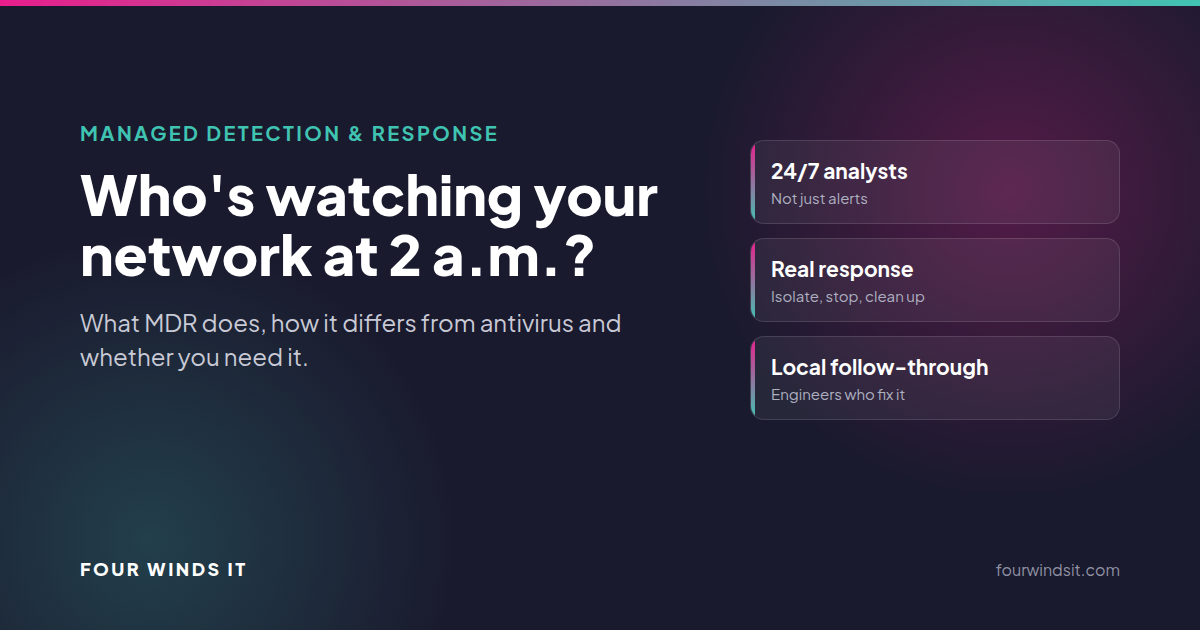
Managed detection and response (MDR) is a team of security analysts watching your computers and cloud accounts around the clock, with the authority to stop an attack the moment they see it, like cutting an infected laptop off the network at 2 a.m. Antivirus sends an alert. MDR sends a person who acts on it. For most small businesses, it's the difference between a scare and a shutdown.
Here's the real question: when something suspicious happens on your network at 2 a.m. on a Saturday, who sees it, and what do they do? For most businesses the honest answer is "an alert goes to an inbox, and someone reads it Monday." Attackers count on that.
Key takeaways
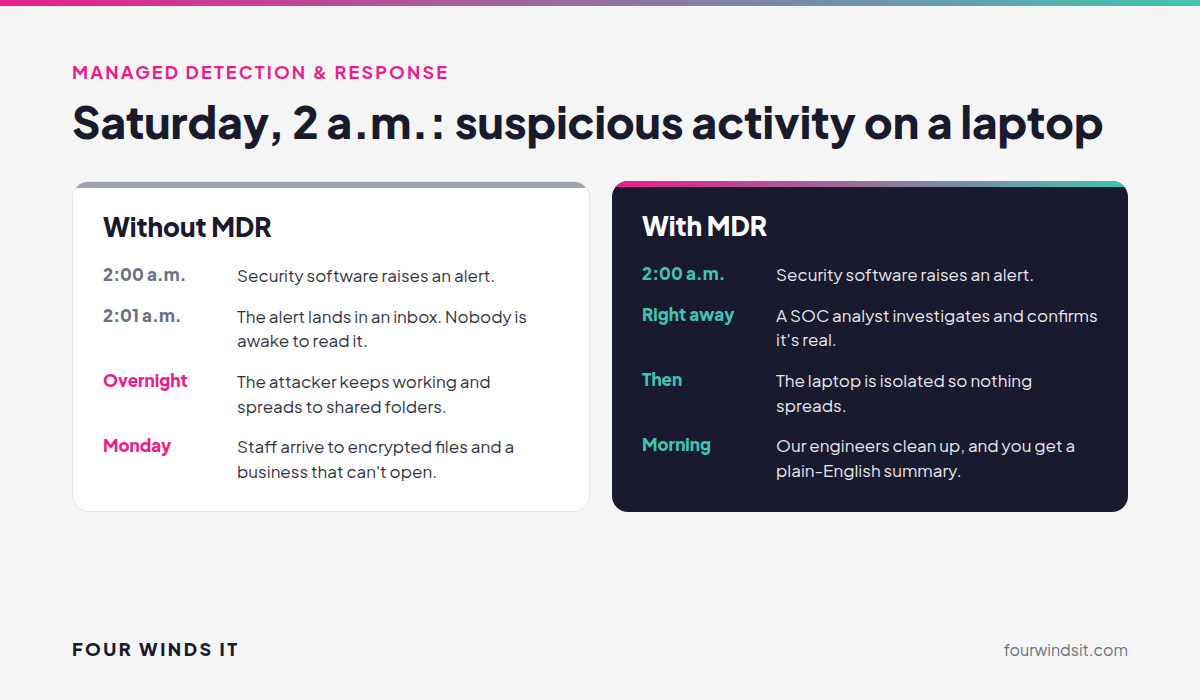
Think of it as a security guard for your computers who never goes home. Software on each device and in your cloud accounts watches for suspicious behavior: a program trying to encrypt files, a login using tools attackers favor, a process reaching out to a known bad server. When something looks wrong, an analyst investigates it. If it's real, they act on it right then: isolating the device, killing the process, blocking the connection. Then they tell you what happened and what they did.
Blackpoint describes its approach as "24/7 human-led response," and puts it this way: "We act first and ask questions later, alerting you after we've already begun remediation." That's the part a small business can't do on its own.
Traditional antivirus looks for known bad files. Modern attackers often don't use any. They log in with stolen passwords and use the same built-in tools your IT team uses, which look normal to software that's only checking files. Even good endpoint protection that spots unusual behavior still produces alerts that someone has to understand and act on.
What most businesses don't realize is that most small companies don't have anyone watching at night. Our own office is staffed from 7 a.m. to 6 p.m. Eastern, with on-call engineers after hours. MDR adds a security operations center that watches every hour in between.
Our guide to antivirus vs. EDR explains the device-level side in more detail.
If any of these are true, it's worth a serious look:
A few years ago, a round-the-clock security operations center was something only large companies could afford. MDR services like Blackpoint make it practical for a 20 to 75 person business.
Our cybersecurity framework groups security layers into three tiers so it's easier to see what makes sense when. The tiers aren't packages: you can add any layer on its own. MDR sits in the "Insured" tier, alongside security awareness training, a password manager and DNS filtering, the controls cyber insurance carriers ask about. Businesses with regulatory requirements often add layers from the "Compliant" tier, like a SIEM that collects logs across your whole environment and a 24/7 SOC reviewing them. See how our SOC and MDR services work, or take our cybersecurity tier quiz to see where you land.
MDR is a service where security analysts monitor your devices and cloud accounts 24/7, investigate suspicious activity and take action to stop threats, such as isolating an infected computer, instead of just sending an alert.
Antivirus is software that blocks known threats and raises alerts. MDR adds trained people who watch around the clock, investigate what the software finds and respond immediately, including to attacks that don't use any malware at all.
A security operations center (SOC) is the team and the operation. MDR is a service delivered by a SOC, focused on detecting and stopping threats on your devices and cloud accounts. A full SOC with a SIEM also reviews logs from firewalls, servers and applications across the whole environment.
In normal use, no. The monitoring runs quietly in the background. Most people only notice it if their device is isolated because of a real threat.
The analyst investigates and, if it's real, contains it right away, often by isolating the device. Our on-call engineers are notified, and we follow up to clean up, restore anything affected and explain what happened.
MDR is priced per device per month, and you can add it to your Four Winds IT agreement on its own. We group it in our "Insured" tier because it's one of the controls cyber insurance carriers ask about, but every security layer we offer is chosen individually.
We get it. You can't staff a security team around the clock, and you shouldn't have to. We pair Blackpoint's 24/7 SOC with local engineers in Sarasota who clean up and get people back to work, with same-day on-site help when you need it. Talk to our team about what's watching your network today.

Investing in cybersecurity with SentinelOne can save your business money and prevent costly cyberattacks. Learn why prevention is better than...
 Dylan Borden : Aug 31, 2026, 7:45:00 AM
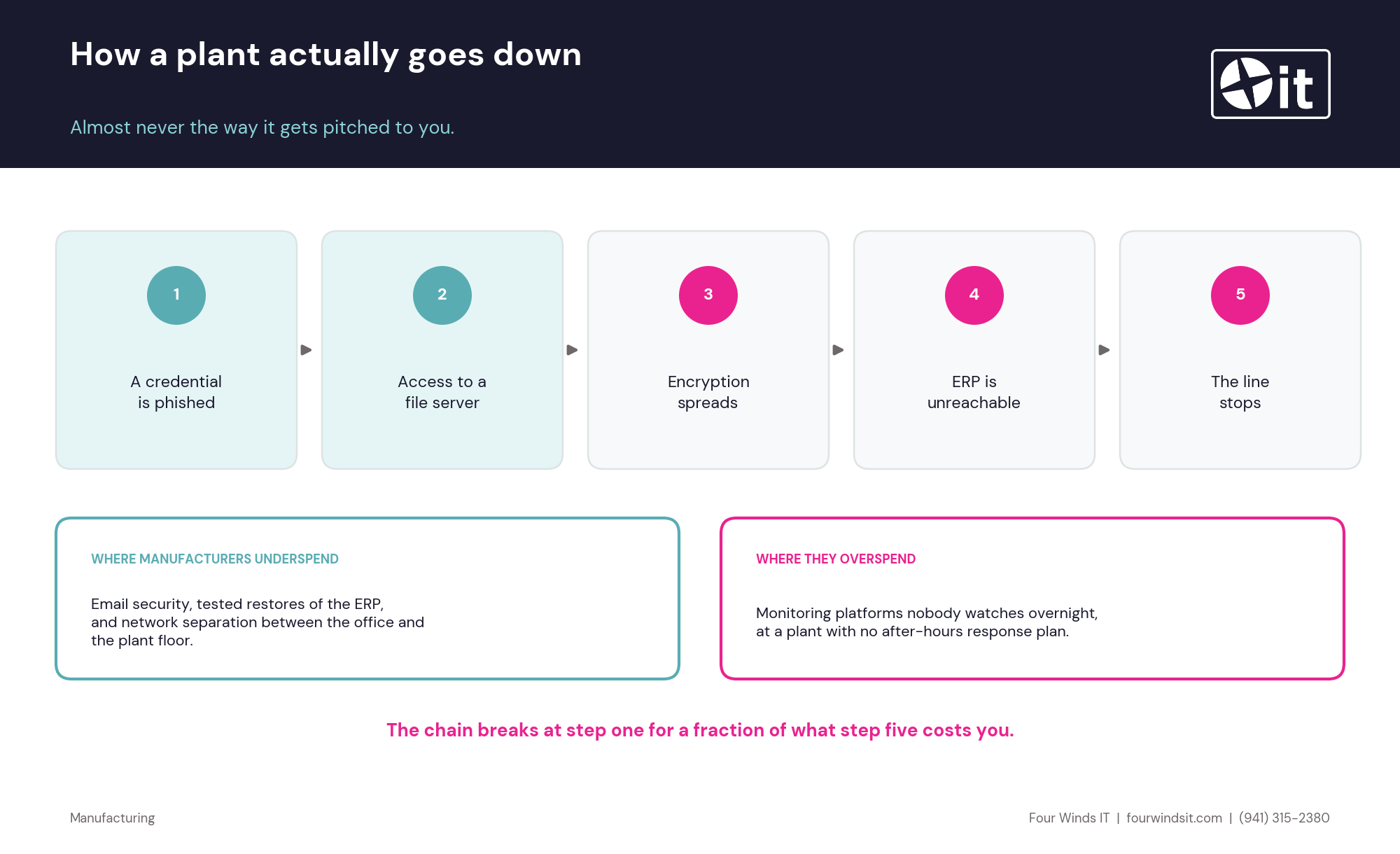
Ranked by whether it keeps the line running: what protects production hours, what does not, and the ERP restore test most Manufacturers have never...
 Dylan Borden : Aug 3, 2026, 12:14:12 PM
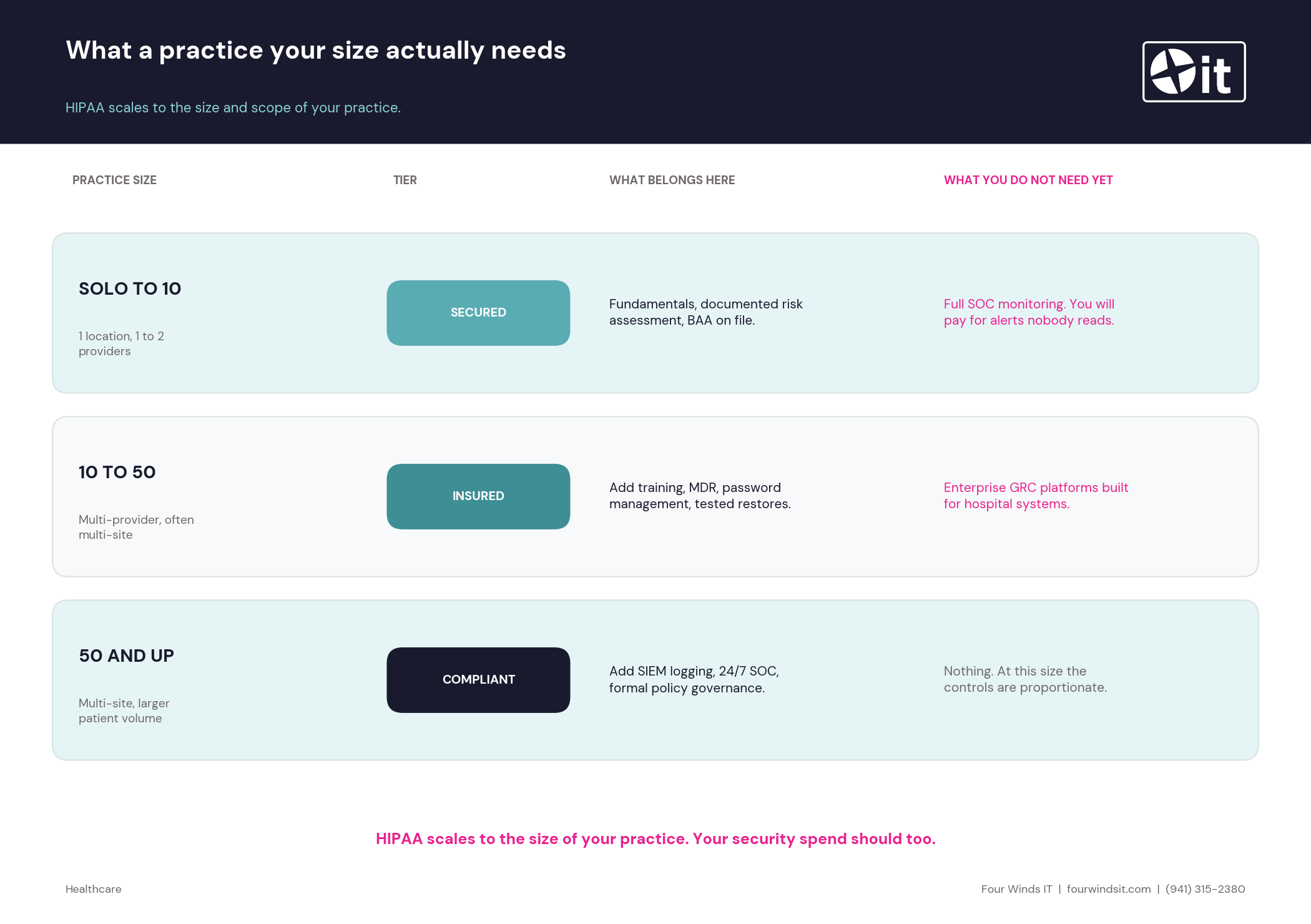
Looking right-sized security healthcare? See which security tier a practice your size actually needs, where practices overspend, & what fails audits.
