
The SEC Is Now Asking How You Govern AI. Most Firms Can’t Answer.
 Dylan Borden : Jun 29, 2026, 8:30:00 AM
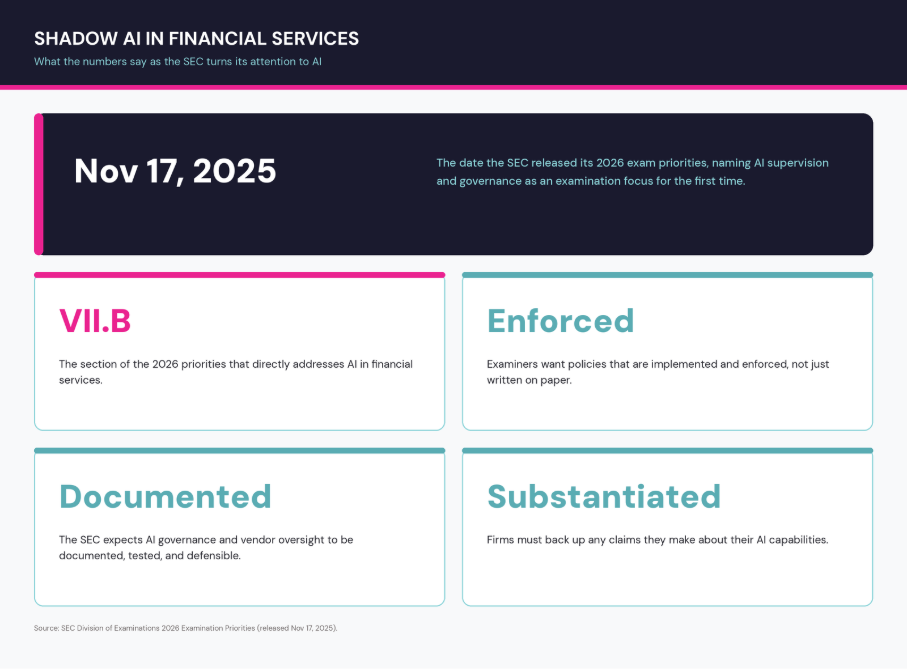
The SEC’s 2026 priorities name AI governance as an exam focus. Why shadow AI is the gap examiners look for, and how to close it.
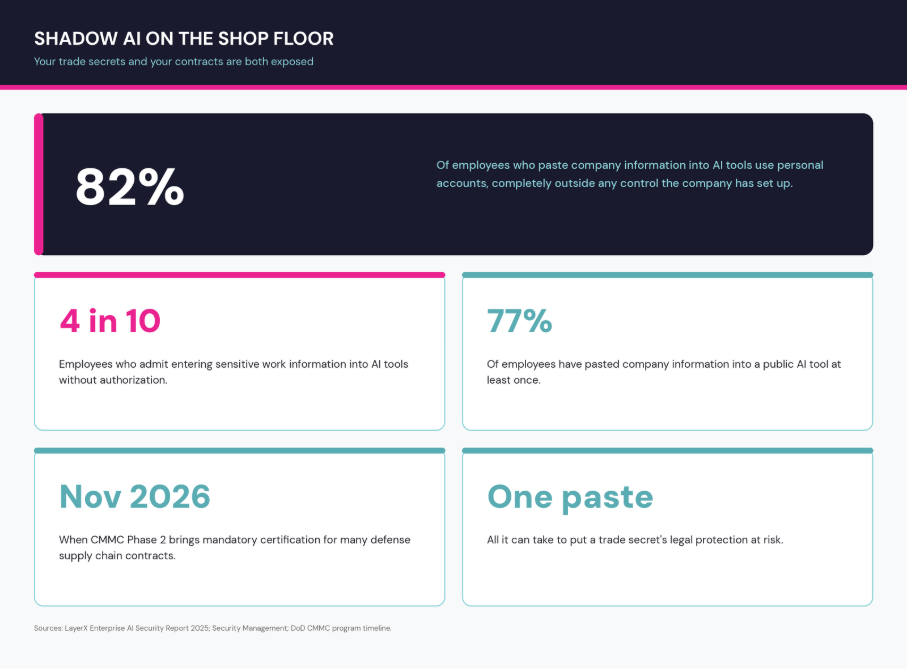
A well-meaning engineer pastes a proprietary design into a free chatbot to troubleshoot it. An estimator drops your real pricing into ChatGPT to draft a quote faster. Neither of them is trying to do anything wrong. Both of them may have just put one of your trade secrets at risk.
Here is the part most manufacturers do not know. A trade secret only holds up in court if you can show you took reasonable steps to keep it secret. That protection is not automatic and it is not permanent: you can lose it through your own actions. Hand the information to an outside party and a court can decide it was never really a secret at all. Pasting it into a public AI tool can count as exactly that kind of disclosure. The engineer’s intent does not matter. One well-meaning paste can quietly strip the legal protection that made the secret worth anything, and you would not find out until you tried to enforce it and could not.
This is shadow AI: staff using AI tools nobody approved, with information that should never leave your company. We manage IT and security for manufacturers across Southwest Florida, so here is the straight version: why this is a bigger deal for manufacturers than most realize, how it collides with your customer contracts, and what to do about it without slowing your team down.
For most businesses, shadow AI is a data-privacy problem. For a manufacturer, it hits two things at once, and both of them are core to the business.
Designs, tooling, process methods, formulations, pricing, customer lists. The proprietary knowledge that is your actual competitive advantage. When that gets pasted into a public AI tool, two bad things can happen. The tool’s provider may use it to train future models, and separately, the act of disclosing it to an outside platform can undermine its legal status as a trade secret. Once that protection is gone, it can be very hard to get back.
Manufacturers increasingly sign contracts that carry security requirements: protect this data, control who can access it, be able to show how you handle it. Ungoverned AI use is a direct hole in those obligations. You cannot promise a customer you are protecting their data while your staff are quietly feeding related information into tools you do not control and cannot see.
This is not a rare edge case. It is happening at most companies right now, manufacturers included.
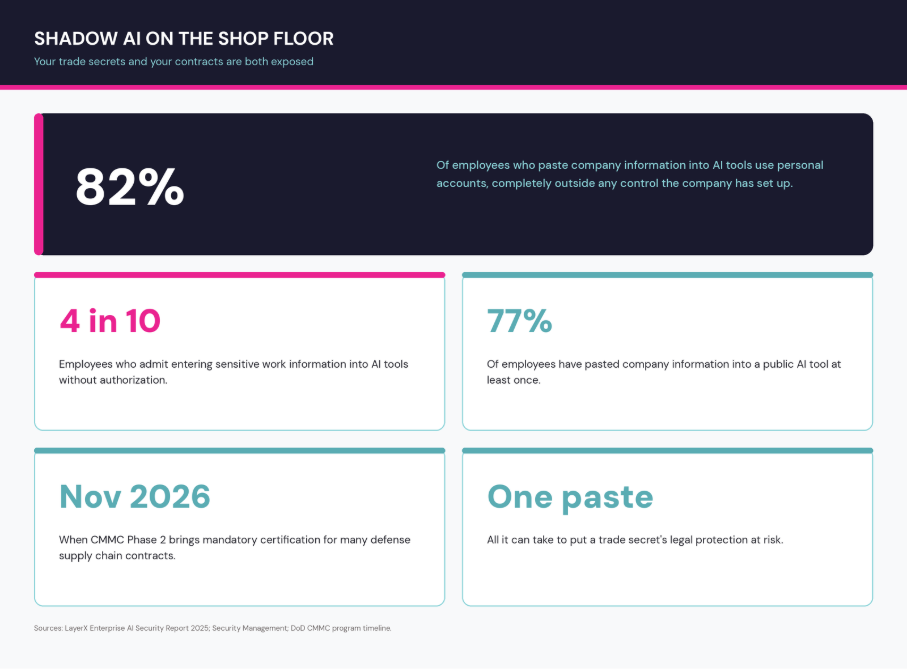
The most telling number is the personal-accounts one. The large majority of staff who use AI at work do it through personal accounts, completely outside anything the company set up. That is the heart of the visibility problem: this activity is happening on personal logins, on personal phones, where the company has no window into it at all.
For the subset of manufacturers in the defense supply chain, there is a specific, dated version of the contract pressure: the Cybersecurity Maturity Model Certification, or CMMC.
The timeline is real and underway. CMMC Phase 1 began November 10, 2025, and runs through November 2026, with the Defense Department able to require Level 1 or Level 2 self-assessments in contracts. Phase 2 begins November 10, 2026, and brings mandatory third-party Level 2 certification for many contracts handling controlled information. Most manufacturers handling Controlled Unclassified Information will need Level 2.
And readiness is low. As of late 2025, only about 431 organizations had achieved a final Level 2 certification, roughly half a percent of the estimated 80,000 companies the DoD expects will need it. Ungoverned AI is one more gap between where a shop is today and where a contract will require it to be. If this is your world, shadow AI is not just an IP risk, it is a compliance gap with a deadline.
If you do not sell into defense, CMMC does not apply to you. But the underlying logic, that your customers expect documented control over sensitive data, is spreading well beyond defense. CMMC is just the clearest, most concrete example of where the bar is heading.
If “shadow AI” still sounds abstract, here is where it shows up in a manufacturing business. It is rarely one careless person. It is reasonable shortcuts spread across roles.
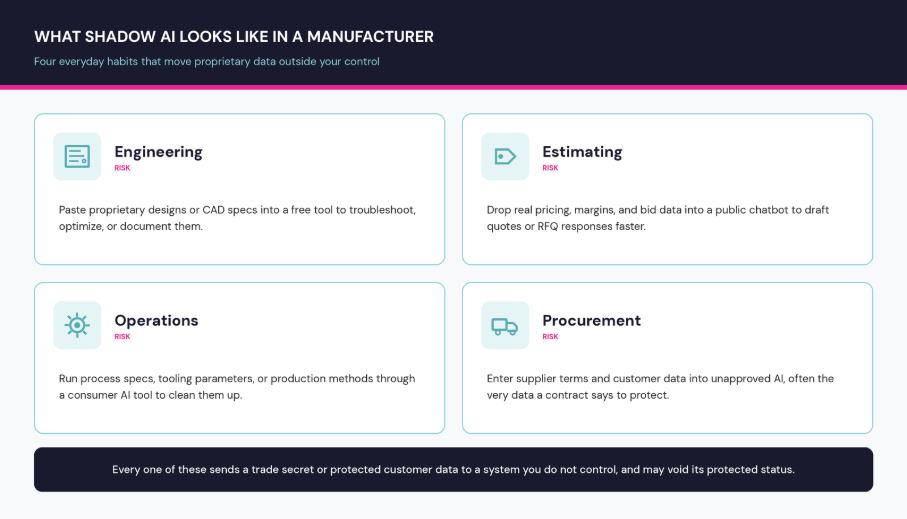
Engineering pastes a proprietary design into a free tool to troubleshoot it. Estimating drops real pricing and margins into a public chatbot to speed up a quote. Operations runs process specs through a consumer tool to clean them up. Procurement enters supplier terms and customer data, often the very data a contract says to protect, into an unapproved app.
Every one of those is legitimate work, done by good people trying to move faster. And every one of them, done in a free public tool, sends a trade secret or protected customer data to a system you do not control. The tasks are fine. The tool is the problem, and the fact that you cannot see any of it is the bigger problem.
Here is the good news: this is solvable, and the answer is not “ban AI and fall behind your competitors.” A ban is actually the weakest move available, and the data shows why. When companies ban AI outright, staff do not stop. They move to personal accounts, which is exactly why that 82 percent number is so high. A ban does not end the risk, it just pushes it somewhere you cannot see.
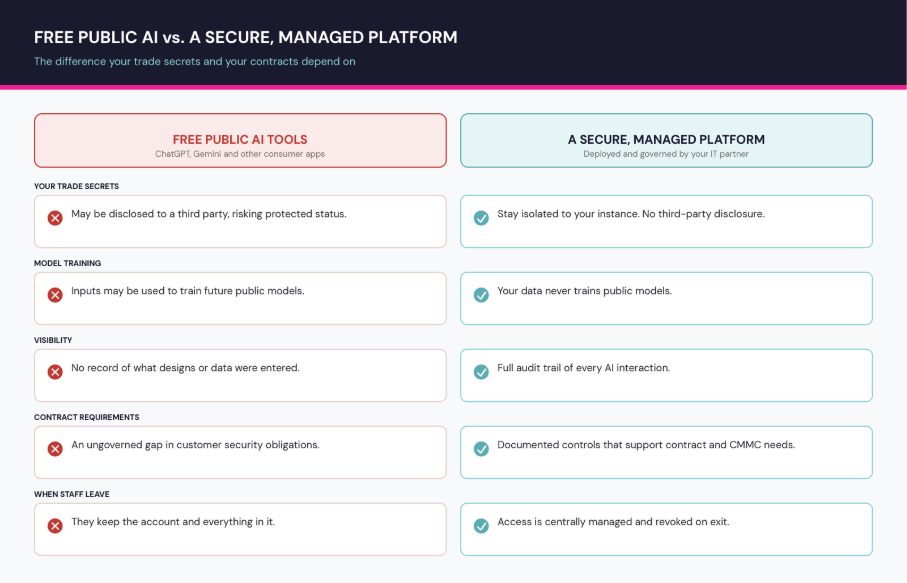
The fix is to give your team one secure AI platform the company controls, then a simple policy for it. This is an infrastructure decision, the same kind you already make about your ERP or your network. A secure, organizationally managed AI platform protects both things that are at risk:
And here is what manufacturers miss when they are stuck thinking of AI as only a risk: the same platform that closes the gap is also a real productivity tool. Secure, pre-built workflows for RFQ responses, spec documentation, maintenance write-ups, and the daily paperwork that slows your people down, all inside guardrails. This is not about replacing skilled workers. It is about giving them a safe way to do what they are already trying to do with the free tools.
One more thing worth saying plainly: this is not a six-figure enterprise project. Pricing scales with how your company actually uses it, and most manufacturers start with one or two use cases and expand from there once they see it work.
You do not have to solve all of this at once. If ungoverned AI is a blind spot right now, here is a sensible order of operations.
Most manufacturers we talk to have no clear picture of how AI is being used across their team, and no policy in place. The first step is just finding out where you stand.
We built a short Shadow AI Risk Self-Assessment for exactly this. It takes a few minutes, it is free, and there is nothing to download or sign up for. You answer a handful of straight questions about how your company handles AI, and you get a clear read on your exposure.
If you would rather just talk it through, that works too. Call us at (941) 315-2380 and we will give you an honest picture of where you stand. No pressure, no pitch.
We Teach This in the Room
Keep designs and pricing out of free tools.
The simplest control is a rule your floor will remember. The AI Traffic Light sorts information into green, yellow and red before anyone pastes anything. Designs, pricing and customer data are red. Get it free, or have us run the session for your team, in person or remote.
It can. A trade secret only stays protected if you took reasonable steps to keep it secret, and disclosing it to an outside party can forfeit that protection. Entering it into a public AI tool can be treated as exactly that kind of disclosure, and employee intent does not change the exposure. The risk is that you do not discover the protection is gone until you try to enforce it against a competitor. The safe path is to keep proprietary data out of public tools entirely.
CMMC applies to manufacturers in the defense supply chain that handle Federal Contract Information or Controlled Unclassified Information for the Department of Defense. If you do not sell into defense, CMMC does not apply to you, but similar customer-driven security requirements are increasingly common in commercial contracts, so the underlying need to govern AI use still applies.
Shadow AI is staff using AI tools the company never approved or secured, often with proprietary designs, pricing, process data, or customer information. It is a risk because it moves trade secrets and protected data into systems the company cannot control, see, or document.
A ban is usually the weakest option. Staff tend to keep using AI on personal accounts, which is why the large majority of workplace AI use already happens outside company control. A more effective approach is to give the team one secure, sanctioned AI platform plus a simple policy, so the safe option is also the easy one.
Start by asking, without making it punitive, since most staff use these tools to keep up with the workload. From there, an organizationally managed AI platform gives you real visibility into who is using AI and for what. Our Shadow AI Risk Self-Assessment is a quick, free way to gauge your current exposure.
Dylan Borden runs operations at Four Winds IT, a managed IT company headquartered in Sarasota, Florida. Four Winds serves manufacturers and businesses across Southwest Florida with a focus on transparent pricing, security that fits the size of your company, and actually answering the phone. Connect with Dylan →
 Dylan Borden : Jun 29, 2026, 8:30:00 AM
The SEC’s 2026 priorities name AI governance as an exam focus. Why shadow AI is the gap examiners look for, and how to close it.
 Dylan Borden : Jun 1, 2026, 7:00:01 AM
Your staff is already using AI with privileged client files. Why shadow AI threatens privilege, what it costs, and how a secure AI platform closes...
 Dylan Borden : Mar 4, 2026, 7:30:00 AM
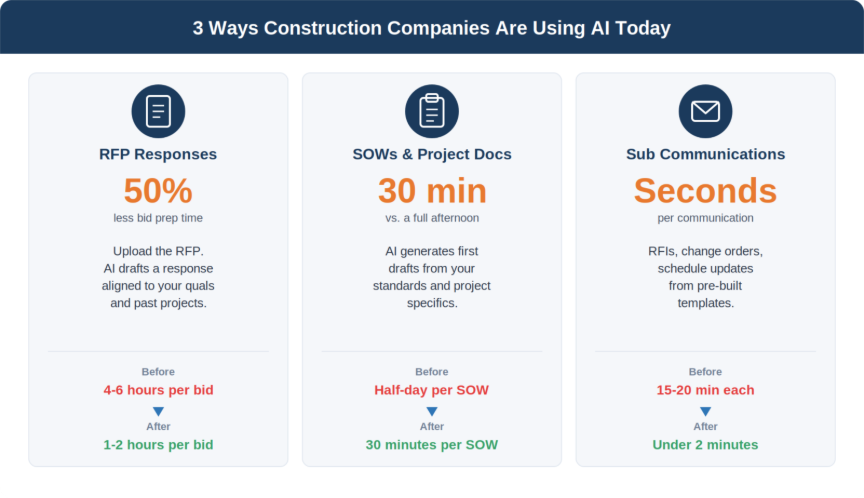
Your estimator can handle 3x more RFPs with secure AI tools. See how construction companies are using AI for bids, SOWs, & project docs today.
